
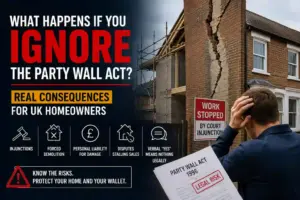
Home improvements can be exciting — a rear extension, loft conversion, basement work, or even removing an internal wall can completely transform your property. But in the rush to get builders booked and work started, many homeowners overlook one important legal requirement: the Party Wall etc. Act 1996.
Many think it is simply unnecessary documentation. While some claimed a brief chat with the neighbour was sufficient. However, neglecting the Party Wall Act can result in costly disputes, legal proceedings that delay your projects and sometimes even demolition work ordered by the courts.
If you are planning building work near a shared wall or boundary, understanding the risks could save you thousands of pounds and months of stress.
What Is the Party Wall Act?
The Party Wall etc. Act 1996 is a UK law that helps prevent and resolve disputes between neighbours when construction work affects shared walls, boundaries, or nearby buildings.
The Act applies to many common home improvement projects, including:
- Loft conversions
- Rear and side extensions
- Basement excavations
- Cutting into shared walls
- Removing chimney breasts
- Building near neighbouring foundations
No, a Project that is within the Act needs to be served with a Party Wall Notice Wiltshire from you before any works commence.
In this way, neighbours are able to see the plans, voice their concerns, and secure property rights.
The Biggest Mistake Homeowners Make
The most common misconception is that you can just get verbal permission from a neighbour.
A neighbour might casually say:
“No problem, go ahead.”
However, without following the written procedures in place, that means very little legally.
The noise, the dust, the cracking walls, the delays, or the worries about structural integrity can quickly spoil a relationship. A neighbour who may have started off quite laid back might later deny even having agreed to the works.
Homeowners are completely naked without the right notices and documentation.
You Could Face a Court Injunction
Ignoring the Party Wall Act Wiltshire can result in your neighbour applying for an injunction through the courts.
An injunction is a legal order forcing work to stop immediately.
This can happen even if:
- The project is already underway.
- Builders are on site.
- Materials have been ordered.
- Large sums of money have already been spent.
In many cases, the court may halt the project until the correct Party Wall procedures are completed.
That delay alone can become incredibly costly.
Builders may charge standby fees, scaffolding hire may continue, and project schedules can collapse.

Yes, You Could Be Forced to Undo the Work
Many homeowners assume the worst-case scenario is simply filling out paperwork late.
Unfortunately, it can go much further than that.
If work causes damage or breaches legal requirements, the court can order changes to the structure — and in extreme cases, require parts of the work to be removed altogether.
You could spend tens of thousands on an extension, only to be asked to make structural changes or to have it partly demolished.
Though a full demolition order is rare, the cost to the homeowner is both financially and emotionally higher stakes than what can be written off as simply breaking some zoning laws Wiltshire.

You Become Personally Liable for Damage
The Party Wall Act exists partly to protect both homeowners and neighbours if damage occurs.
Without a proper Party Wall Agreement Wiltshire and Schedule of Condition, proving whether damage existed before the work began becomes far more difficult.
That creates a dangerous situation.
If your neighbour claims your building work caused:
- Cracks in walls
- Subsidence
- Damp issues
- Structural movement
- Damage to floors or ceilings
You may struggle to defend yourself.
A simple disagreement today could become an expensive legal or insurance problem tomorrow.

Neighbour Disputes Can Turn Toxic Very Quickly
Neighbour disputes can become far more stressful than most people expect.
This can lead to what begins as a trivial disagreement over a point of dust or sounds exquisite.
- Hostile communication
- Complaints to the council
- Solicitor letters
- Delayed projects
- Long-term tension between households
For most homeowners, the emotional strain is worse than the financial aspect.
Good neighbours are incredibly valuable — especially when living in terraced or semi-detached homes. Ignoring legal procedures can damage those relationships permanently.
Selling Your Home Later Could Become Difficult
Party Wall issues do not always disappear once construction ends.
When selling a property, buyers and solicitors may ask for evidence that previous building work complied with legal requirements.
If there is:
- No Party Wall Agreement
- An unresolved dispute
- Ongoing neighbour complaints
- Evidence of structural issues
It can raise serious concerns during conveyancing.
Some sales are delayed or even collapse entirely because buyers fear inheriting legal or structural problems.
Unresolved disputes can also make buyers wary in a tightly contested property market, so if they do not settle quickly enough, it could drive down prices and weaken your negotiating position.

Insurance Problems Many Homeowners Never Consider
Ignoring the Party Wall Act can also create insurance complications.
Some insurers may question claims involving structural damage if proper legal procedures were not followed before work began.
That means homeowners may end up covering repair costs themselves.
Contractors’ insurers may also become involved in disputes about liability, especially if no formal records exist showing the original condition of neighbouring property.
The legal and insurance side of construction disputes often becomes far more complicated than homeowners expect.
When Does the Party Wall Act Actually Apply?
Many people accidentally ignore the Act simply because they do not realise their project falls under it.
The Act commonly applies when:
- Building on or near a boundary line
- Excavating within certain distances of neighbouring structures
- Altering shared walls
- Inserting steel beams into party walls
- Underpinning or basement works are planned.
Even relatively small projects can trigger legal obligations.
This is why professional advice before work starts is so important.
The Cost of Following the Rules Is Usually Far Less
Some homeowners avoid the Party Wall process because they want to save money or avoid delays Wiltshire.
Ironically, ignoring it often becomes far more expensive.
The cost of:
- Surveyors
- Notices
- Agreements
- Legal compliance
It is usually tiny compared to:
- Court action
- Construction delays
- Compensation claims
- Legal fees
- Repair work
- Lost property sales
If you always follow the right process up front, most of the time it will save you from big problems later on.

Final Thoughts: Prevention Is Always Cheaper Than Conflict
The Party Wall Act is not there to stop home improvements Wiltshire. It exists to protect everyone involved and reduce the chance of serious disputes.
Most neighbours Wiltshire are reasonable when communication is clear, formal procedures are followed, and concerns are handled properly.
But relying on verbal agreements or hoping problems will not arise is a huge gamble — especially when major construction work is involved.
Before starting any project near a shared wall or boundary, take the legal side seriously.
A small investment of time today could save you from costly legal and financial issues in the future.
FAQs
Q: What can happen if I begin building work without serving a Party Wall Notice first Wiltshire?
If you start work without giving the correct Party Wall Notice, your neighbour may be able to take legal action against you or request a court injunction to stop the project. This can result in costly delays, legal expenses, and unnecessary disputes.
Q: Can my neighbour force me to stop my extension or loft conversion if I ignored the Party Wall Act requirements Wiltshire?
Yes. If the Act applies to your project, a neighbour can ask the court to halt the work until the legal process is properly followed.
Q: Is a verbal agreement from my neighbour legally enough to protect me during Party Wall building work?
No. Verbal agreements offer very little legal protection if disputes arise later. Proper written notices and agreements are strongly recommended.
Q: What happens if my neighbour claims my building work caused cracks or structural damage to their property Wiltshire?
When a neighbour claims your construction work caused damage to their home, proving otherwise can be complicated if you do not have clear evidence or records in place. This could result in disputes, repair bills, or potential legal action against you.
Q: Can failing to follow the Party Wall Act cause problems when selling my property later on?
Yes. If Party Wall notices or agreements are missing, or disputes remain unresolved, it can create issues during the conveyancing process and may slow down or impact the sale of your property.
Q: Do I still need to follow the Party Wall Act if my neighbour initially said they were happy with the work Wiltshire?
Yes. Even if your neighbour agrees verbally, the legal process should still be followed correctly to avoid future disputes.
For further information, please call US on 03300 101 381